Speeches
Ministerial Statement on Impact of the Middle East Situation on Singapore by Acting Minister for Transport and Senior Minister of State for Finance Mr Jeffrey Siow
Topics
Parliament
7 April 2026
1. Mr Speaker, the Deputy Prime Minister has set out how the Middle East conflict will affect Singapore’s economy.
a. I will now explain what the Government is doing to support our businesses, our workers, and our households through this period.
2. On the 12th of February this year, the Prime Minister and Minister for Finance presented our largest Budget on record, at $155 billion.
a. We could not know about the conflict that would break out in Iran, but we could see many uncertainties ahead, and therefore the need to provide greater reassurance and support in this Budget.
b. Hence PM Lawrence Wong announced substantial broad-based support measures, including a Corporate Income Tax rebate, CDC Vouchers, and the Cost-of-Living Special Payment.
c. We provided more support for lower-wage workers and households, such as enhancements to the Progressive Wage Credit Scheme and better support for lower-income families through ComLink+.
d. We also enhanced U-Save rebates, giving 1.5 times the regular amount – or up to $570 this financial year.
e. The first tranche of U-Save rebates will be disbursed in April. This will help to defray the increase in utility bills from April to June.
f. A second tranche of U-Save rebates will be disbursed in July. And this should help to defray the much sharper increase in utility bills from July to September, that we expect with the spike in oil prices.
3. 16 days after the Budget, the United States and Israel launched coordinated airstrikes on Iran. This current situation in the Middle East remains highly uncertain. We cannot predict how exactly events will unfold, or when the conflict will end.
4. What we do know is that Singaporeans are already feeling some of the effects on the ground.
a. In Singapore, petrol and diesel prices have already risen sharply in tandem with global oil prices, and are likely to remain elevated for some time.
b. And while the impact has not yet fully filtered through for items such as electricity or food, we have to brace ourselves because we know, from experience, that this will come.
5. The Government is not waiting to act.
a. We will supplement what was announced in the Budget with a further package of support measures.
b. These provide targeted support to those who are the most heavily and directly affected.
c. We will also provide broad-based support for businesses and households.
d. And let me go through these in turn.
Support measures
6. First, support for the domestic transport sector.
a. The sharp increase in fuel prices had an immediate effect on the earnings of platform workers, private hire car drivers and taxi drivers.
b. NTUC has worked with platform and taxi operators on fuel vouchers and fare adjustments, which have helped to cushion the impact.
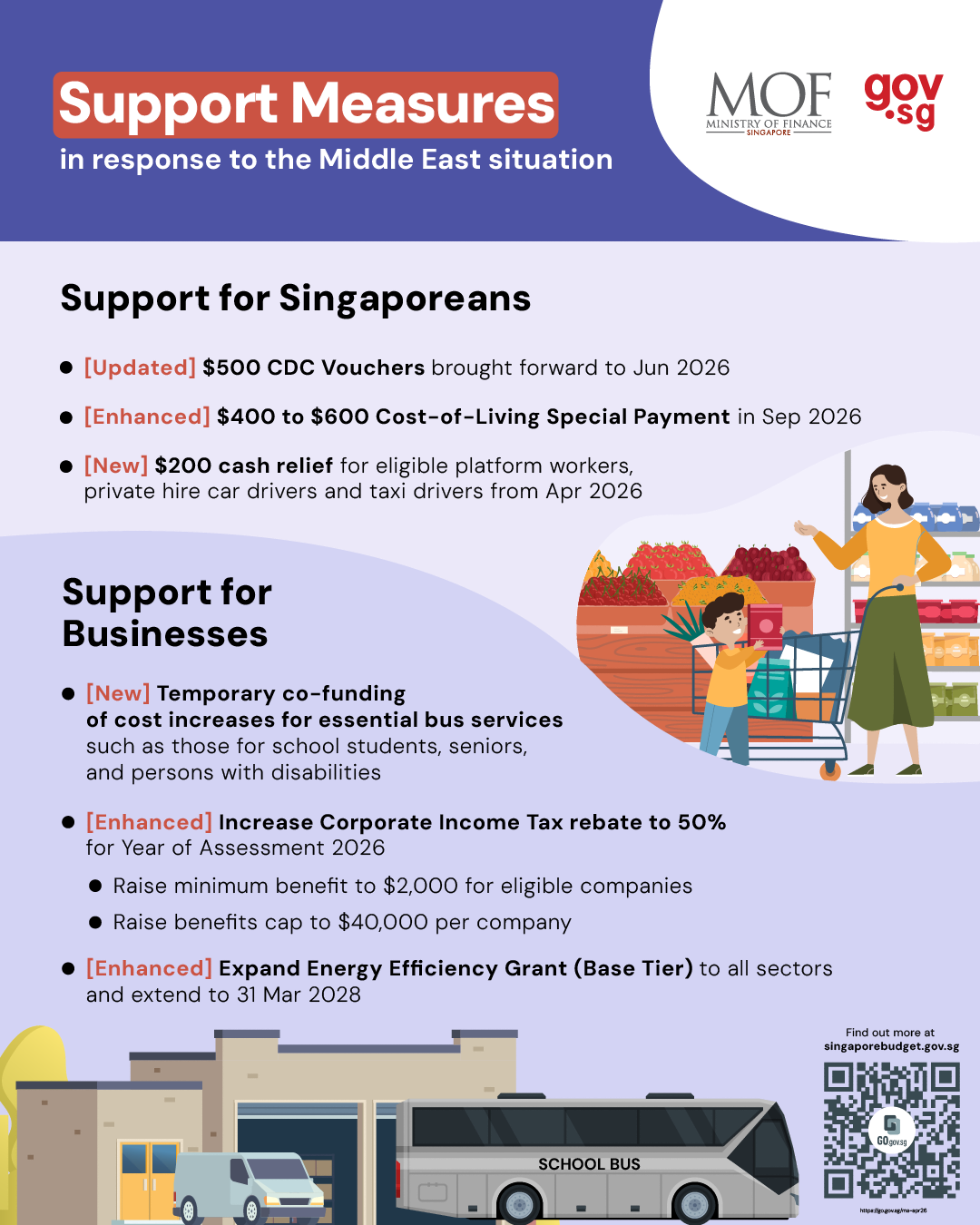
c. To provide further relief, the Government will disburse $200 in cash to active platform workers, private hire car drivers and taxi drivers from the end of the month.
7. For certain essential bus services, such as those for school students, seniors, and persons with disabilities, the Government will provide temporary assistance to co-fund cost increases, to enable these services to continue operating without disruption.
8. The respective government agencies will provide more details.
9. Several Members have asked if the Government will consider reducing fuel or diesel duties across the board.
a. We do not think this would be the right move. It is too blunt an approach, and it could also be regressive. At the same time, we want to preserve the price signals for consumers to use energy more efficiently.
b. And more fundamentally, as an open economy, we must allow fuel prices to reflect market realities. If prices are artificially suppressed, importers may choose to divert fuel where prices are higher, and over time, this can tighten supply and leave us worse off.
c. Instead, our targeted approach provides direct support to those who are directly affected, and this allows us to channel more help to those who need it most.
10. Second, let me talk about support for businesses.
a. Higher energy and logistics costs will continue to be felt by businesses across the economy for some time. Our SMEs in particular are more vulnerable to sudden cost increases.
b. To help businesses manage cashflow, we will enhance the Corporate Income Tax rebate announced at Budget from 40% to 50% for the Year of Assessment 2026.
i. We will also raise the minimum benefit that a company with at least one local employee will receive, from $1,500 to $2,000.
ii. The total benefits cap for each company will be raised from $30,000 to $40,000.
iii. We will disburse this enhancement quickly – as early as the end of this month.
11. Even as we roll out immediate relief, this challenging period is also a timely reminder for all our businesses to build longer-term resilience against high and sustained energy prices. And we will support them to do so.
a. Businesses that invest in energy efficiency will reduce their exposure to volatile energy prices and lower their long-run operating costs.
b. We currently have an Energy Efficiency Grant which applies to six designated sectors, for example, Food Services, Retail, Manufacturing, and Construction. Companies in these sectors can make use of the grant to invest in new, energy-efficient equipment.
c. We will now expand the base tier of this grant to all sectors, and extend this support for another year, to 31 March 2028, so that more companies can benefit.
12. Additionally, some companies in the Energy and Chemicals sector have been badly affected by feedstock supply disruptions. Our agencies are engaging these firms, and assessing how best to provide targeted support to preserve critical capabilities for our economy.
13. Finally, as a responsible buyer, the Government is prepared to share the cost increases directly related to fuel costs, for critical government projects where any delays or stoppages would clearly affect the public interest.
a. This includes major government infrastructure projects, such as the Cross Island MRT Line, and new HDB BTO projects. BCA will issue a circular with more details shortly.
14. Third, let me talk about support for households.
a. We are tracking the prices of food and other essential goods and services very closely. So far, rising fuel prices have not yet fully percolated into wider price increases across the economy.
b. But given the heightened uncertainty in the Middle East, it is still too early to update our projections of inflation in Singapore, or to quantify the full impact on households. But we know the situation has amplified cost of living anxieties for Singaporeans.
c. Therefore, to reassure Singaporeans that cost increases in the impending months can be managed, we will bring forward the disbursement of the $500 CDC Vouchers announced in Budget this year from January 2027 to June 2026.
d. We will also increase the Budget 2026 Cost-of-Living Special Payment by $200 for all eligible Singaporeans. And this will bring the total quantum of this Special Payment to between $400 and $600 per person. About 2.4 million Singaporeans will receive this additional payment in cash, which will be disbursed in September.
15. Mr Speaker, may I now say a few words in Mandarin please.
16. 中东局势紧张,能源价格上涨,我们理解国人的担忧。政府今天宣布了多项援助措施,为国人提供及时的帮助。
17. 我们也会为最直接受到影响的人士加强援助。比如,德士司机和平台员工,将从四月底获得两百元的现金补助。
18. 政府也会为企业和家庭提供更多的帮助,包括把 2027年1月的五百元CDC邻里购物券提前在今年6月发放。9月发放的生活费特别补助也将调高两百元。
19. 我们还不知道这场危机会持续多久,也不知道影响会有多大。但政府会继续密切关注局势的发展,在有需要的时候采取更多措施,为国人提供援助。
20. 政府一直以来都非常谨慎和负责任地管理国家的资源, 先把资源储备好,有备无患。因此,在遇到危机的时候,政府才有能力帮助人民,不让任何人掉队。
21. 不论遇到什么样的危机,只要大家上下一心,携手应对,我们一定能够渡过这个难关。
Conclusion
22. Mr Speaker, the Government has put together a substantial first response to the energy crisis caused by the Middle East conflict.
a. We do not know how long the conflict and its economic impact will last.
b. But the Government is alive to the situation. We have drawer plans, and as events develop, we can put them into action and do more if the situation calls for it.
23. This package adds up to close to $1 billion in additional measures, on top of what has been previously committed in Budget 2026. It is much larger than our immediate response in 2022, after war broke out in Ukraine and caused a similar surge in oil and gas prices.
a. To fund these measures, the Government will work within the amount approved in the Supply Act last month in the first instance, and seek Parliament’s approval for the supplementary budget later on.
24. Mr Speaker, this is neither the first crisis we have weathered, nor will it be the last.
25. What Singaporeans can count on is a Government that is well-prepared, builds sufficient buffers, anticipates problems and thus is ready and able to respond swiftly with solutions.
a. We will always make sure that no Singaporean is left to bear his or her burden alone.
26. Thank you, Mr Speaker.